Summer Homeschool Without a Curriculum
If summer homeschool without a curriculum is the goal, the question isn’t whether your kids will learn. It’s whether you’ll have anything to hold the days together. For K–3 families who want to keep learning alive this summer without recreating the school year, you’re in the right place.
Most summer homeschool ideas you’ll find online are one-off activities with no thread connecting them. What works better is a rhythm built around two or three anchor points each day. Whether you have one child or you’re managing a kindergartner and a third grader at the same time, this approach works in a real home without requiring a separate plan for every kid.
For more structured planning support, the homeschool planning posts and Family Plan unit studies on this site are a good place to start.
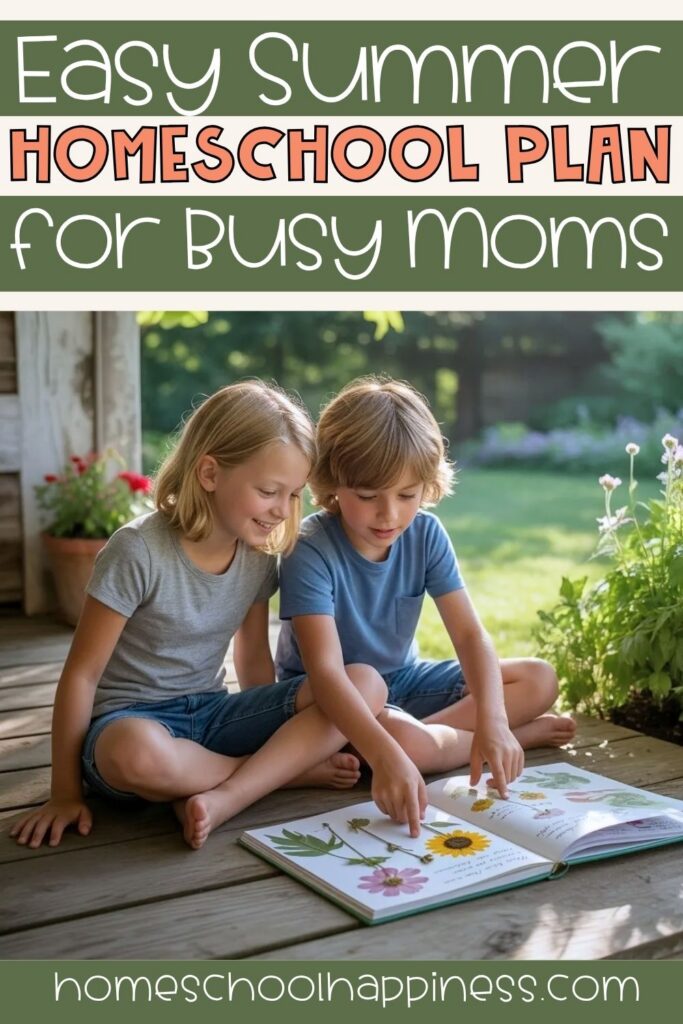
What Does Summer Homeschool Look Like Without a Curriculum?
Summer homeschool without a curriculum means building a rhythm around a few anchor activities rather than a daily subject schedule. Most families do well with one read-aloud, one hands-on project, and a short skill-maintenance block each day. That’s enough to keep learning alive without turning summer into a second school year.
The Difference Between a Summer Plan and a Summer Curriculum
A curriculum has a scope and sequence. It has objectives, a defined end point, and the quiet pressure of staying on track. That’s exactly what makes it useful during the school year and exhausting to think about in June.
A summer plan is something different. It’s a rhythm, not a schedule. It has intention without the weight of coverage. You’re not trying to finish anything. You’re trying to keep the thread.
| Summer Curriculum | Summer Plan | |
|---|---|---|
| Structure | Daily subject schedule | A few anchor activities |
| Goal | Cover new material | Maintain rhythm and prevent drift |
| Pressure level | High | Low |
| Flexibility | Limited | Built in |
| What it feels like | School in July | Learning that fits summer |
The fear underneath all of this is usually the same: what if they fall behind? It’s a fair concern, but a summer without structure and a summer without a curriculum are not the same thing. Kids don’t lose ground because they took a break from textbooks. They lose ground when the days have no shape at all.
A simple plan gives the summer a shape. It keeps reading happening, keeps math from going completely cold, and gives your kids something to look forward to each day. It just doesn’t look like school. That’s the point.
What to Keep, What to Let Go
Not everything needs to follow you into summer. Part of having a plan is deciding in advance what stays and what gets a real break, so you’re not making that call every morning when the day falls apart.
Here’s a simple way to think about it.
Keep, lightly: Reading is worth protecting. Even 15 to 20 minutes a day keeps fluency from sliding and honestly takes almost no effort if the book is good. Math fluency is the other one worth a light touch, not new concepts, just enough practice to keep what they already know from going fuzzy. A daily read-aloud counts for both of these things and barely feels like school when the book is something everyone actually wants to hear.
Let go completely: Spelling lists, grammar worksheets, science curriculum, history spine, writing assignments. All of it can wait until fall. A summer break from formal subjects is not a gap in your child’s education. It’s a reset, and resets are part of the plan.
The goal isn’t to squeeze learning into every corner of summer. It’s to protect a few things that matter and give everything else a genuine rest.

How to Build a Simple Summer Rhythm (Not a Schedule)
A rhythm is not a schedule. A schedule tells you what happens at 9:15. A rhythm tells you what happens before lunch. That distinction matters more than it sounds when you’re trying to keep summer from feeling like school.
The simplest version of a summer homeschool rhythm has three anchor points: something to start the day, something in the middle, and something that wraps it up. For most K–3 families, that looks something like a read-aloud after breakfast, a short independent work block before lunch, and an activity or project in the afternoon. None of those need to be long. Thirty to forty-five minutes of intentional learning spread across the day is enough.
The read-aloud is the anchor that holds everything together, especially if you have kids at different grade levels. A good book works for a kindergartner and a third grader sitting on the same couch. You don’t need two separate plans for two separate kids. You need one book everyone wants to listen to and a few minutes afterward to talk about it.
The independent work block is where the light skill maintenance happens. That’s your math fluency practice, your independent reading, your short writing prompt if you use one. Each kid works at their own level for 15 to 20 minutes. That’s it.
The afternoon anchor is the loose one. A nature walk, a hands-on project, a unit study activity. Something that feels more like summer and less like school. This is where learning gets to be interesting without any pressure attached to it.
Three anchors. Flexible timing. Real kids in a real home. That’s the whole framework.

What This Actually Looks Like in June
After eighteen years of homeschooling, I can tell you that the summers with a little intention behind them were always better than the ones without. Not because we accomplished more. Because the days had enough shape that nobody felt lost in them, including me.
Our summer mornings always started slower than the school year. That was intentional. Nobody was rushing to finish anything by a certain time. But there was still a rhythm, and that rhythm is what kept June from turning into four weeks of everyone wandering around asking what to do next.
The read-aloud was the one thing that never went away, even in our most relaxed summers. After breakfast, we read together. It didn’t feel like school. It felt like something we wanted to do. And looking back, those books did as much for my kids’ language and thinking as anything we covered in a formal lesson.
Before lunch, the kids had an independent work block. Short, simple, level-appropriate. The younger ones might do a math activity or some drawing and writing. The older ones read on their own or worked through a prompt. Twenty minutes. Then it was done and nobody thought about it again until the next day.
Afternoons were loose. Sometimes a project, sometimes a unit study, sometimes almost entirely unstructured. All of it worked. What made the difference was never how much we did. It was whether the day had a shape at all.
That’s the whole thing. A shape. Not a schedule.
Summer doesn’t have to be a choice between losing ground and running school through July. There’s a lot of space between those two options, and a simple rhythm lives comfortably in the middle of it.
You don’t need a curriculum to keep your kids learning this summer. You need a few anchors, a book everyone wants to hear, and permission to let the rest wait until fall. That’s a plan. And a plan is enough.

Hi, I’m Tara—mom of three, former teacher, and now full-time homeschooler. After years in both preschool and public school classrooms, I brought the learning home and never looked back. At Homeschool Happiness, I share real-life tips, simple activities, and encouragement to help you create a homeschool life that feels good for your family—one filled with connection, laughter, and meaningful moments. We’re in this together!


