Simple Homeschool Plan: What to Include and Where to Start
If you’re not sure what a simple homeschool plan should actually include, you’re in the right place. The overwhelm usually isn’t about effort. It’s about not having a clear picture of what you’re building toward.
Whether you have one child or you’re juggling multiple kids at different levels, this works in a real home without turning your living room into a classroom. Most moms can pull together a working plan in one sitting, and everything here is designed to feel like a plan, not a project.
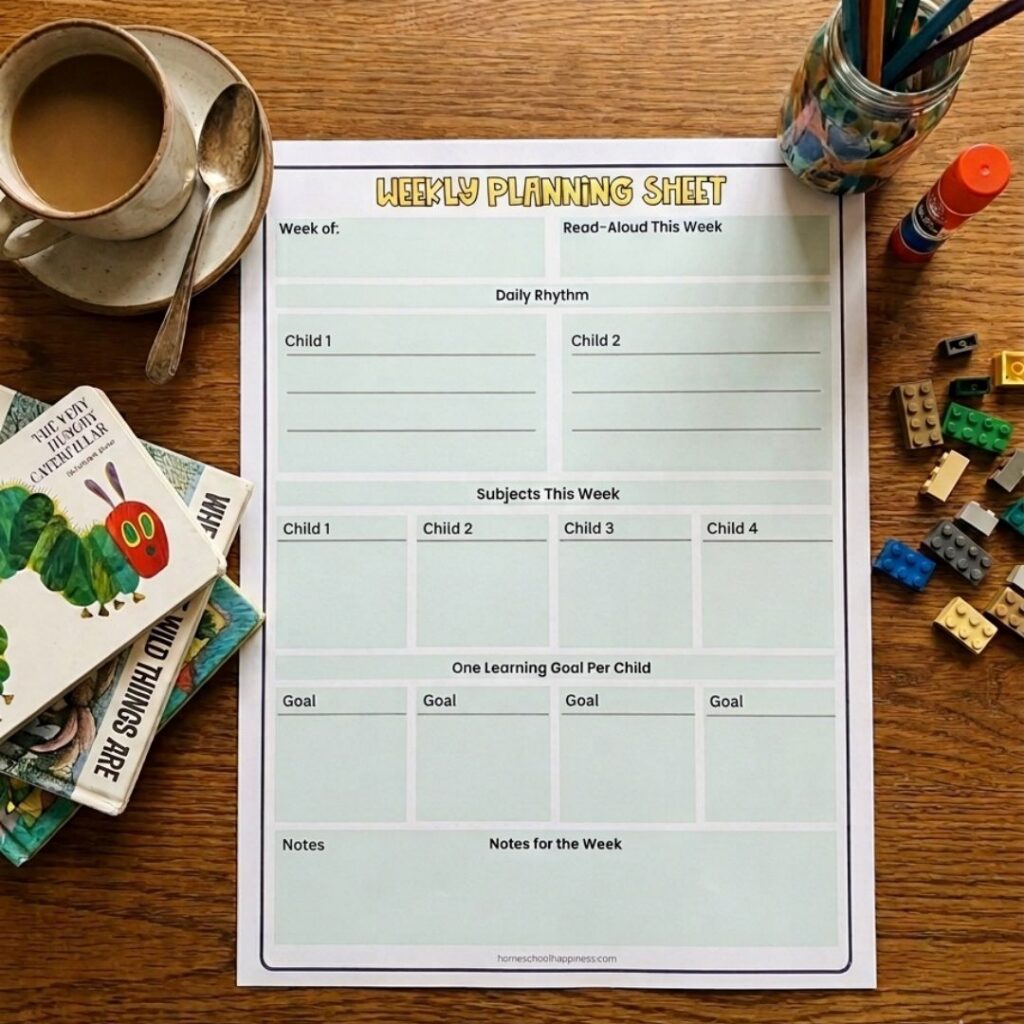
There’s also a free one-page planning template at the bottom of this post. Grab it before you finish reading and fill it in as you go.
What Does a Simple Homeschool Plan Actually Include?
A simple homeschool plan for kindergarten and early elementary grades needs four things: a daily rhythm, a short subject list, a read-aloud anchor, and one clear learning goal per child. You don’t need a detailed schedule or a stack of curriculum. You need enough structure to know what comes next and the flexibility to adjust when real life happens.
Start with a Daily Rhythm, Not a Schedule
The first mistake many homeschool moms make is trying to build a schedule before they have a rhythm. A schedule tells you that math happens at 9:15. A rhythm tells you that math happens after breakfast and before read-aloud. One falls apart the moment someone spills their cereal. The other just keeps going.
A daily rhythm is simply the order your day moves in. It doesn’t have times attached to it. It doesn’t require everyone to be seated and ready at the same moment. It just gives your day a shape so you’re not starting from scratch every morning trying to figure out what comes next.
Here’s what a simple rhythm might look like:
Morning time together, reading and math for each child, read-aloud, independent work or play, done.
That’s it. Five parts. No clock required. You’ll adjust it over time to fit your family, but starting with a loose order of events is almost always easier than starting with a timed block schedule you’ll abandon by Wednesday.
If you’ve ever felt like your homeschool day just falls apart before noon, the rhythm is usually what’s missing, not more curriculum or a better planner.
Keep Your Subject List Short (Especially in the Early Grades)
One of the fastest ways to burn out in homeschool is trying to teach every subject every day. It feels responsible. It feels like enough. But for most families, especially in the early years, it creates more chaos than it solves.
Here’s what actually matters in the early grades: reading, math, and a daily read-aloud. That’s your core. Everything else, science, history, art, handwriting, can be woven in gradually as your kids build stamina and your rhythm gets more consistent. You are not behind because you are not doing everything right now.
The guilt usually comes from comparing a homeschool day to a school day, and that comparison was never fair to begin with. A classroom teacher has 25 kids and six hours to fill.
You have your kids, your home, and a much shorter window of focused learning time that is actually more effective than it looks. A 90-minute homeschool morning done consistently will take your kids further than a packed six-subject day that leaves everyone fried by lunch.
So if your list right now is reading, math, and books, that is not a short list. That is a strong foundation. Add to it when it feels easy, not when the guilt gets loud.
Use a Read-Aloud to Anchor the Whole Family
If there is one thing that can hold a homeschool together across multiple ages and subjects, it is a daily read-aloud. It is the one part of your day where everyone stops, sits together, and learns the same thing at the same time, regardless of grade level or ability.
This matters more than most moms realize when they are just starting out. A shared read-aloud gives your day a natural gathering point. It builds vocabulary, background knowledge, and listening skills across every age simultaneously. Your kindergartner and your third grader are both getting something from the same book, just at different depths. You are not running two separate schools. You are running one family that learns together.
It also makes teaching multiple grades feel far less like a juggling act. When you have a strong read-aloud spine anchoring your week, everything else has something to connect back to. Science, writing, geography, even math concepts can grow out of what you are already reading together as a family.
If you have more than one child and you are trying to figure out how to teach different grades without doubling your prep time, the read-aloud is where that solution starts. For a deeper look at how to build on that shared anchor across grade levels, our post on teaching the same topic to multiple grades at once walks through exactly how that works in practice.
Set One Learning Goal Per Child
A simple homeschool plan does not need a list of academic objectives for every subject. What it needs is one clear sense of direction for each child. Not a lesson target. Not a benchmark. Just a honest answer to the question: what do I most want my child to grow in this season?
That might be building the habit of sitting and focusing without being reminded. It might be gaining confidence with reading out loud. It might be learning to write a complete thought without help. These are not curriculum goals. They are the kind of quiet, real growth that actually shapes a child’s learning over time, and they give your daily decisions something to anchor to.
When you have a learning goal for each child, it becomes much easier to decide what to prioritize on a hard day, what to let go of without guilt, and whether your plan is actually working. It shifts the measure of success from “did we finish everything” to “is my child moving forward.”
Here’s a simple starting point by grade level:
What a Simple Learning Goal Looks Like by Grade
| Grade | What to Focus On | Example Learning Goal |
|---|---|---|
| Kindergarten | Building the habit of learning at home | Sit and engage with a lesson for 10 to 15 minutes without losing focus |
| 1st Grade | Growing independence in the basics | Read independently for 10 minutes without prompting |
| 2nd Grade | Strengthening output and follow-through | Write a complete sentence about what she learned each day |
| 3rd Grade | Building self-direction | Complete one task from start to finish without being reminded |
Your goal does not have to be academic. For some kids in some seasons, the most important growth is learning to stay calm when something is hard, or learning to try before asking for help. A plan that accounts for the whole child is a better plan.
Where to Start if You Have No Plan
If you are reading this with no plan in place and a low-grade feeling that you are already behind, start here: write down what your day already looks like.
Not what you wish it looked like. Not what you think it should look like. What it actually looks like right now. When do your kids wake up? When are they most alert? When does everything tend to fall apart? Your plan needs to fit inside your real day, not the ideal version of it, and you cannot build that fit until you can see what you are actually working with.
From there, pick one subject to start with tomorrow. Just one. Most moms do best starting with read-aloud because it requires nothing from the kids except to listen, and it gives the day an immediate sense of purpose and connection. Do that one thing consistently for a week before you add anything else.
That is not a small plan. That is a plan that will actually hold.
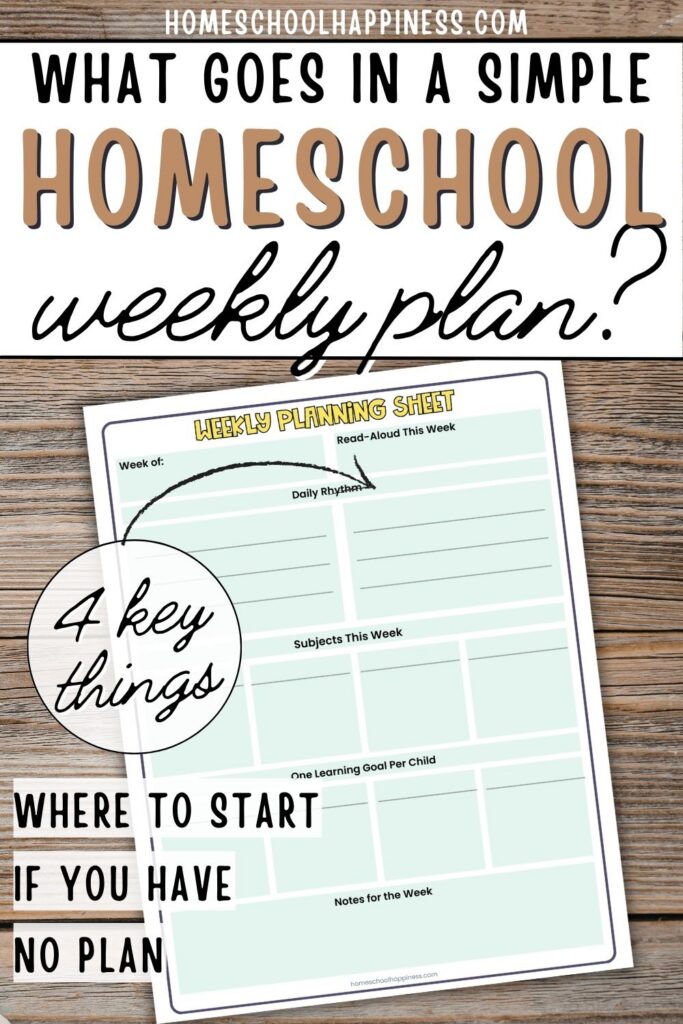
A simple homeschool plan does not have to be complicated to work. It needs a rhythm that fits your real day, a subject list short enough to actually follow, a read-aloud that brings your family together, and one honest goal for each child. That is enough to build on.
Most moms do not need more information before they can start. They need a clear enough picture to take the first step. If you have that now, the next move is simple: grab the free planning template below and fill in what you know. You do not have to have it all figured out. You just need somewhere to put it.

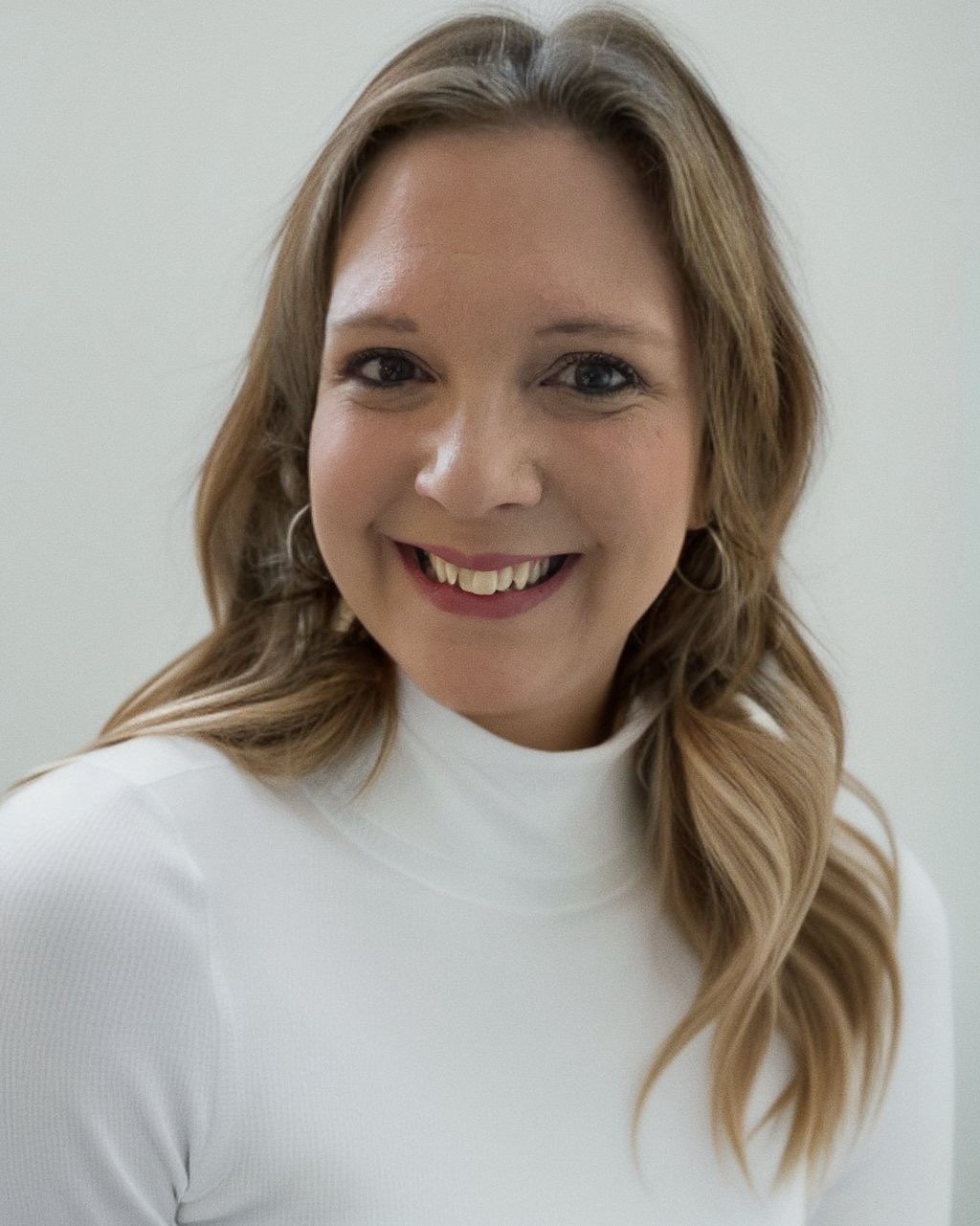
Hi, I’m Tara—mom of three, former teacher, and now full-time homeschooler. After years in both preschool and public school classrooms, I brought the learning home and never looked back. At Homeschool Happiness, I share real-life tips, simple activities, and encouragement to help you create a homeschool life that feels good for your family—one filled with connection, laughter, and meaningful moments. We’re in this together!


