How to Teach the Same Topic to Multiple Grades at Once

If teaching the same topic to multiple grades sounds like it should be simpler than it is, you’re not wrong. Homeschool moms with kids at different levels know the feeling: one child needs something hands-on and simple, another is ready for real writing, and somehow you’re supposed to make it all work in the same morning. This post walks you through a two-part structure that pulls it all together without doubling your prep.
Whether you have two kids or more, whether they’re one grade apart or four, this works in a real home without a separate lesson plan for each child. Most families can run the anchor and follow-up work in a single morning block, and everything here is designed to feel like a plan rather than a pile of activities grabbed from different places.
How to Teach the Same Topic to Multiple Grades at Once
The most effective approach is to anchor all your kids to one shared topic, then differentiate the activities by grade level. Start with a read-aloud or hands-on anchor activity the whole family does together, then assign grade-specific follow-up work. This keeps prep manageable, builds shared vocabulary, and keeps your homeschool running as one unit instead of two or three separate schools.
Why Teaching the Same Topic Across Grades Works
If you’ve ever spent Sunday night building two completely different lesson plans, one for your kindergartner and one for your second grader, you already know what this approach fixes.
When all your kids learn the same topic at the same time, a few things happen that don’t happen any other way. They start using the same vocabulary at dinner. Your older child explains something to the younger one, and they both understand it better for it. And you prep once instead of twice.
This isn’t a shortcut. It’s actually how kids in multi-age environments have always learned. Older kids reinforce their own knowledge by hearing it explained simply, and younger kids absorb more than we expect when the topic is present and alive in the house all week.
The work looks different at each grade level. It should. But the topic is shared, and that shared thread is what makes your homeschool feel like one cohesive thing instead of two schools running in the same room.
The Two-Part Structure That Makes It Work
Teaching across multiple grades gets complicated when every child is doing something completely different. The fix is a simple two-part structure: a shared anchor followed by grade-level follow-up work. That’s it.
Part 1: The shared anchor
This is what everyone does together. It sets the topic for the day and gives all your kids a common starting point before they go off to work at their own level. A shared anchor can be a read-aloud, a short video, a map activity, a hands-on experiment, or even a five-minute conversation about what you’re studying. The format matters less than the fact that every child in the room experiences it together.
The shared anchor does something that independent work can’t: it builds vocabulary across grades simultaneously. When your kindergartner and your third grader hear the same word in the same context on the same day, that word becomes part of your household that week.
Part 2: The grade-level follow-up
After the anchor, each child moves to work that fits their level. This is where differentiation happens, and it doesn’t have to be complicated. Your kindergartner draws and dictates. Your first grader writes a few sentences. Your second grader completes a paragraph or a sorting activity. Your third grader works through a research page or a structured writing response.
The follow-up work is independent by design. While one child is drawing and another is writing, you’re free to move between them rather than running separate lessons from scratch.
Together, these two parts give you a homeschool day that feels connected instead of fragmented, and manageable instead of overwhelming.

What the Shared Anchor Looks Like in a Real Homeschool
The shared anchor doesn’t require a lesson plan or a lot of setup. It’s the part of your day where everyone stops and pays attention to the same thing for 10 to 15 minutes. Here’s what that actually looks like.
A read-aloud
This is the most natural anchor for K–3 families. You read aloud, everyone listens, and the topic is introduced without any prep beyond choosing the book. Your kindergartner absorbs the story and the pictures. Your third grader is picking up vocabulary and context they’ll use later in their independent work. One book, one reading, three kids engaged.
A short video
A well-chosen video gives younger kids something visual to hold onto and gives older kids a hook for the deeper work they’ll do afterward. Keep it short, 5 to 10 minutes, and watch it together before anyone splits off to independent work.
A map activity
If your topic has a geography connection, pulling out a map and talking through it together takes less than 10 minutes and gives every grade level something to reference for the rest of the week. Younger kids can point and trace. Older kids can start building context for the writing or research work that follows.
A discussion question
Sometimes the anchor is just a question you ask out loud before the work begins. What do you already know about this? What do you think lives at the bottom of the ocean? It costs nothing, takes two minutes, and gets every child thinking about the topic before they open a single workbook.
None of these requires a separate plan for each child. The anchor is the one thing you prepare. Everything else builds from it.
How to Differentiate the Follow-Up by Grade (K–3)
Once the anchor is done, each child moves to their own work. The goal isn’t to create a separate lesson for every grade. It’s to match the type of task to what each child can actually do independently, so you’re not hovering over anyone while someone else waits.
Here’s a simple way to think about it by grade.
| Grade | After the shared anchor, this child… |
|---|---|
| Kindergarten | Draws and dictates one thing they learned; counts or sorts related objects |
| 1st Grade | Matches vocabulary, writes 2–3 sentences, completes a simple sorting activity |
| 2nd Grade | Writes a paragraph, classifies or compares, works a related word problem |
| 3rd Grade | Completes a short research page, writes a structured paragraph or response, solves multi-step problems |
A few things worth noting. These are types of tasks, not a script. Your kindergartner might be ready for more; your second grader might need a simpler entry point on a hard week. The table gives you a starting framework, not a ceiling.
You’ll also notice that none of these tasks requires you to be present the entire time. That’s the point. The follow-up work is designed to run while you circulate, which is what makes teaching multiple grades in one home actually sustainable.
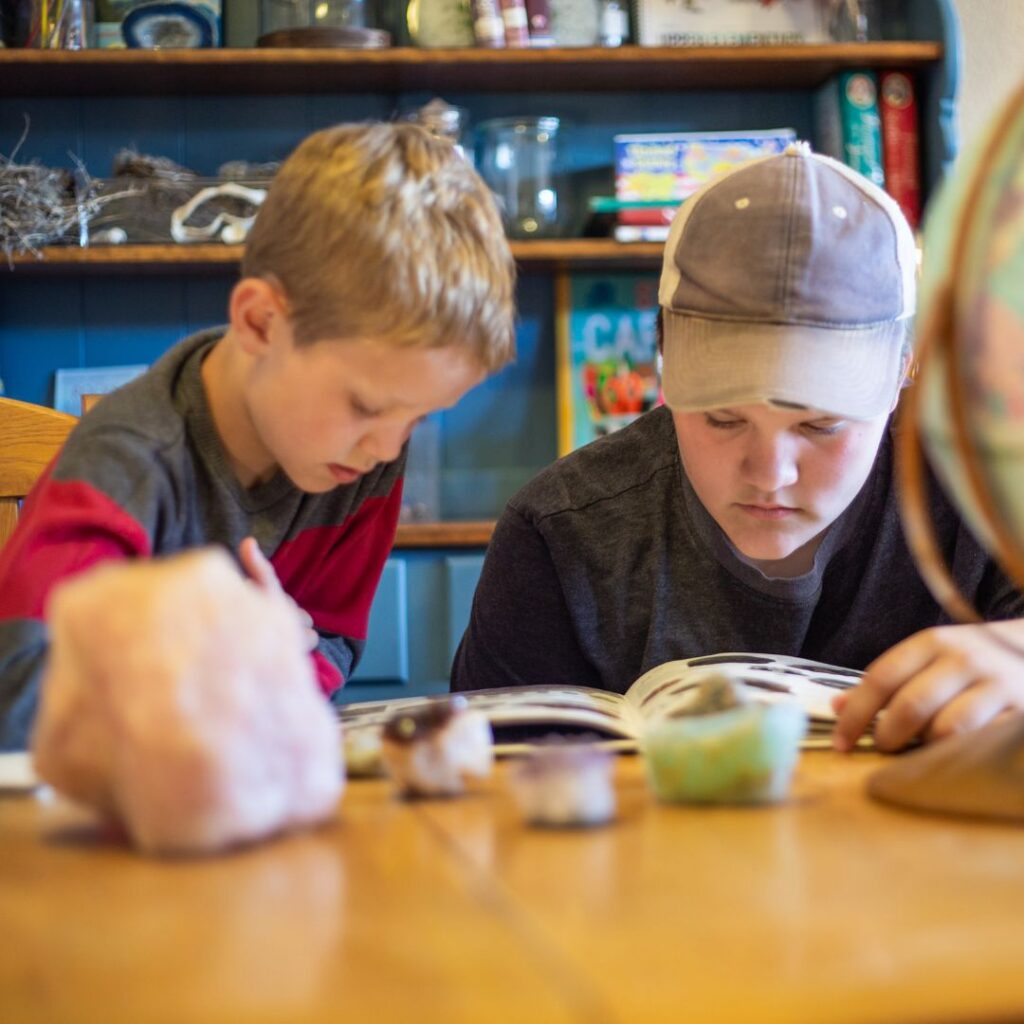
A Simple Example Using One Topic
Let’s put this into practice using a topic most K–3 kids love: ocean animals.
The shared anchor
You gather everyone and read aloud a few pages from a book about ocean creatures. You pause to look at the pictures together, point out a few animals you’ll be learning about this week, and ask one question before sending everyone to their work: what’s the strangest ocean animal you’ve ever heard of?
That’s it. Fifteen minutes, everyone in the room, no separate prep for each child.
The grade-level follow-up
Now everyone moves to their own task.
Your kindergartner gets a simple drawing page. They draw an ocean animal from the book and tell you one thing about it while you write it down for them. Done in 10 minutes.
Your first grader matches a set of vocabulary words to pictures of ocean animals, then writes two sentences about their favorite one. They can do this completely on their own.
Your second grader reads a short passage about ocean zones, fills in a labeled diagram, and writes a paragraph about one zone they found interesting.
Your third grader works through a research page, using the book and any notes from the anchor time to write about an ocean animal’s habitat, diet, and role in the food chain.
You prepped one anchor. Four kids walked away with grade-appropriate work, shared vocabulary, and something to talk about at lunch.
That’s what this method looks like on a regular Tuesday.
What This Does Not Look Like
It helps to name what this method is not, because most homeschool moms have already tried one of two things before landing here.
The Pinterest trap
You search “ocean activities for kindergarten” and “ocean worksheets second grade” and end up with a folder full of unrelated printables that don’t build on each other. Each child is doing something different, nothing connects, and by Wednesday you’ve lost the thread entirely. There’s activity, but there’s no plan behind it.
The school-at-home trap
You try to run two separate lesson sequences, one for each child, with different objectives, different materials, and different schedules. It works for about a week before the prep becomes unsustainable. You’re essentially teaching two schools in one house, and it burns you out fast.
The approach in this post sits between those two. It’s not a pile of random activities grabbed from different corners of the internet. And it’s not a rigid dual-curriculum setup that treats your home like two separate classrooms.
It’s one topic, one anchor, and grade-appropriate follow-up work that each child can do with real independence. Structured enough to feel like a plan. Flexible enough to work in a real home with real kids on a real Tuesday.
Teaching multiple grades at once stops feeling impossible the moment you stop trying to run separate schools and start building around one shared topic.
The anchor brings everyone together. The follow-up work sends each child off at their own level. And you move through your day as one homeschool instead of two or three running in parallel.
This works in a real home with real kids. It works on the days when your kindergartner needs extra help and your third grader is flying through their work. It works when you have 15 minutes for the anchor and not much more. It works because the structure is simple enough to actually hold.
If you want to see this method in action across a full week of subjects, the posts and planning resources here on the site are a good next step. Start with one topic, try the two-part structure once, and see what happens.
You don’t need a perfect plan. You just need a place to start.

Hi, I’m Tara—mom of three, former teacher, and now full-time homeschooler. After years in both preschool and public school classrooms, I brought the learning home and never looked back. At Homeschool Happiness, I share real-life tips, simple activities, and encouragement to help you create a homeschool life that feels good for your family—one filled with connection, laughter, and meaningful moments. We’re in this together!


