10 Engaging Nocturnal Animal Activities for Homeschoolers
If your kids are anything like mine, they light up at the mention of bats, owls, or raccoons. There’s just something magical about the creatures that come alive after dark, which makes nocturnal animal activities a perfect fit for curious young learners.
The best part? You don’t need fancy supplies or hours of prep. These ideas are designed with you in mind — simple, hands-on, and flexible enough to work with one child or a whole group.
Whether you’re exploring new homeschool themes this season or just looking for a fun way to break up your week, you’ll find activities here that weave together science, literacy, art, and play.
And to make planning even easier, don’t miss the free printable checklist waiting for you at the end!

Engaging Nocturnal Animal Activities for Homeschoolers
Below you’ll find ten simple, engaging ideas to help your kids explore the world of nocturnal animals. Each one is designed to spark curiosity while keeping prep and supplies low-stress for you.
From creative writing to hands-on science, these activities blend learning with play so your homeschool days feel both meaningful and manageable.
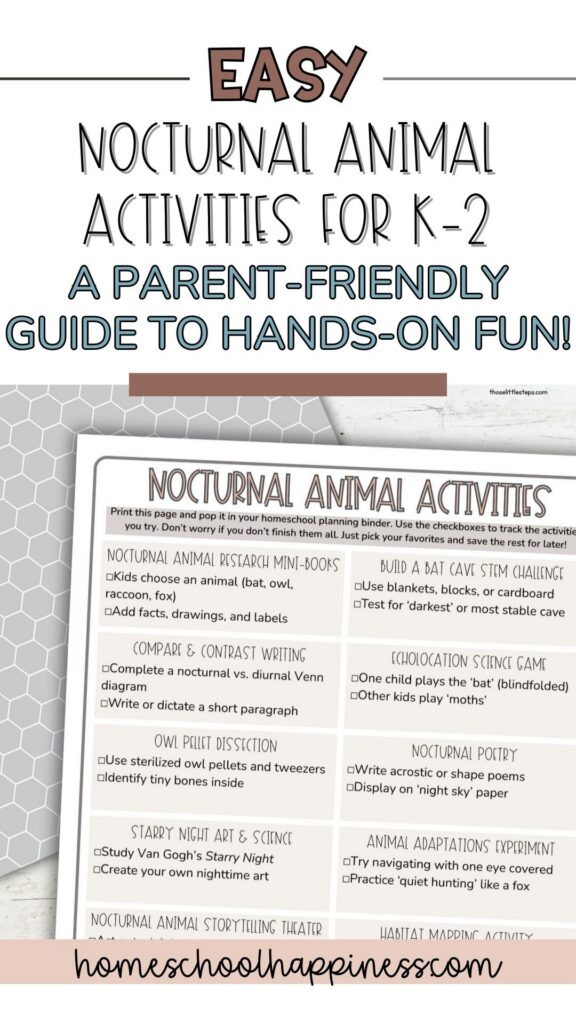
Nocturnal Animal Research Mini-Books
Kids love taking ownership of their learning, and a mini-book is a simple way to do just that. Let them choose an animal like a bat, owl, raccoon, or fox, then fill their pages with facts, drawings, and labels. Younger children can dictate while you write, while older kids can add their own words.
Tip: Save the finished books and bind them into a “Nocturnal Library” for your homeschool shelf.
Build a Bat Cave STEM Challenge
Gather blocks, blankets, or cardboard boxes and invite your kids to design a cozy cave for toy bats. Test which cave stays the darkest or stands the strongest — it’s hands-on engineering without any pressure.
Tip: Add a flashlight test to see which design really keeps the bats hidden.
3. Compare & Contrast Writing
Introduce a simple Venn diagram to explore the difference between nocturnal and diurnal animals. Kids can sort traits into the circles, then turn their notes into a short paragraph, drawing, or oral narration.
Tip: Let younger children use stickers or sketches instead of words.
4. Echolocation Science Game
Play a game that helps kids understand how bats hunt at night. One child wears a blindfold and becomes the “bat,” calling out “echo!” while the “moths” reply with “cation!” It’s a playful way to act out science.
Tip: Choose a safe open space like the living room or backyard so everyone can move freely.
5. Owl Pellet Dissection
Few activities feel as magical as uncovering tiny bones inside an owl pellet. With sterilized kits (easy to order online), your kids can use tweezers to gently uncover the remains of an owl’s last meal. It’s a real-world science lab at your kitchen table.
Tip: Pair this with an owl book to deepen the experience.

6. Nocturnal Poetry
Invite your kids to create acrostic poems using animal names or shape poems in the form of a bat, owl, or raccoon. Poetry feels less intimidating when it’s paired with art and imagination.
Tip: Hang finished poems on dark construction paper “night skies” for instant homeschool art décor.
7. Starry Night Art + Science Connection
Study Van Gogh’s famous Starry Night and then let your kids paint or collage their own night sky. While they work, talk about which nocturnal animals might be awake under those stars.
Tip: End the day with a simple stargazing walk to connect art and real life.
8. Animal Adaptations Experiment
Help your kids experience what it’s like to rely on special nighttime senses. Try covering one eye and walking in dim light like an owl, or listening for soft sounds like a fox hunting.
Tip: Keep it fun and playful — let them see who can sneak the quietest like a nighttime predator.
9. Nocturnal Animal Storytelling Theater
Encourage creativity by acting out “a night in the life” of a chosen animal. Kids can make simple paper masks or just pretend with their imagination. Sequencing, drama, and science all roll together in one activity.
Tip: Record their skit on your phone and play it back for a sweet homeschool memory.
10. Habitat Mapping Activity
Draw simple nighttime habitats like a forest, desert, or wetland, then place animal cutouts in the correct environment. This activity naturally ties geography and science together in a kid-friendly way.
Tip: Reuse the cutouts in your science journal or as part of a lapbook later on.
Learning about nocturnal animals is such a natural way to bring wonder into your homeschool. Whether your kids are building blanket caves, writing bat poems, or peeking into owl pellets, each activity offers a chance to learn through curiosity instead of worksheets alone. And remember, you don’t have to do all ten at once. Choose the ones that fit your week, keep the mood light, and enjoy the little moments of discovery along the way.
To make things even easier, I’ve put together a free printable checklist you can pop into your planning binder. It’s a simple way to keep all these nocturnal animal activities in one spot so you can check them off as you go. Grab it below and let it be your guide to a fun, low-stress unit that your kids will remember long after the lights go out.


Hi, I’m Tara—mom of three, former teacher, and now full-time homeschooler. After years in both preschool and public school classrooms, I brought the learning home and never looked back. At Homeschool Happiness, I share real-life tips, simple activities, and encouragement to help you create a homeschool life that feels good for your family—one filled with connection, laughter, and meaningful moments. We’re in this together!


